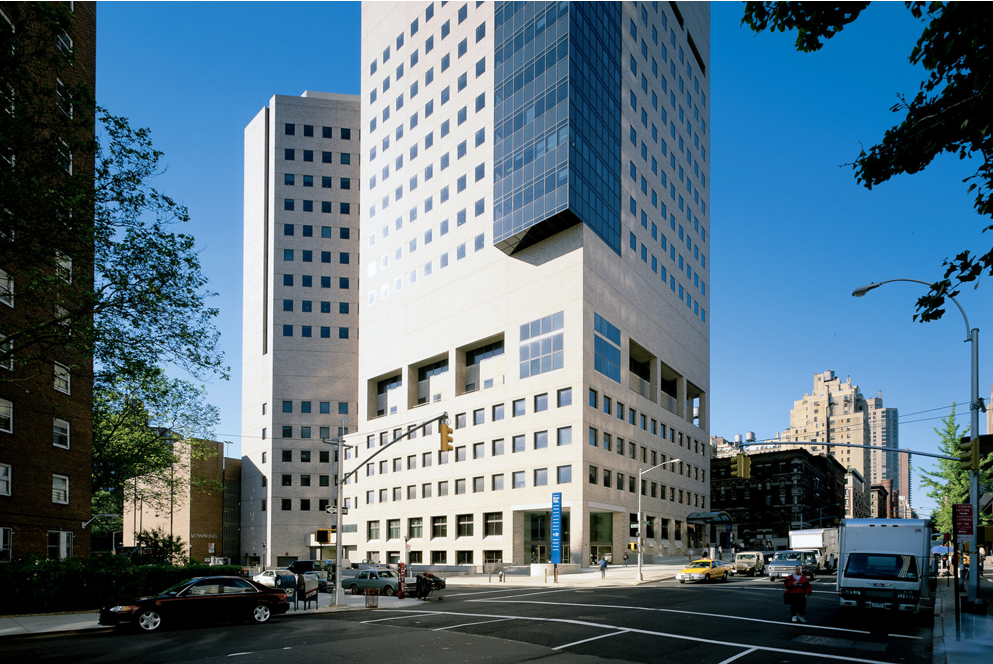
Eduardo Castro was project manager for this 18-story building, providing 350,000 sf of laboratory, treatment, and education space for both the Hospital and the School of Medicine.
Its two-level lobby serves a major auditorium, cafeteria, academic bookstore, faculty club, and Dean’s office. An in-patient psychiatric unit occupies two floors, which are set back from the façade to create terraces and animate the building’s exterior. Research and clinical testing laboratories for oncology, cardio-biology, immunology, molecular genetics, neural aging, and structural biology are located on the upper floors. The lab floor plans use a standard module that permits cost-effective adaptation to different research models, both current and emerging.
A staff and utility tunnel under Madison Avenue ensures the building functions as an integral part of the campus. Other below-grade components include a vivarium and three levels of parking for a total of five basement levels.
The structural system of the building is a steel moment frame with composite floors. Deep plate girders in the perimeter of the building provide the necessary stiffness for the moment frames. The lab floors were designed for stringent vibration limits as required for the lab equipment. The foundation walls are anchored into rock at the base to keep the ground water outside the building.